


Jellyfish

Jellyfish Leadership & Management
Jellyfish Employee Perspectives
Describe the woman on your team you wish to highlight and why you chose to showcase her.
Alexa Lytle joined at Jellyfish over two and a half years ago as a product manager on a new team focused on delivery management. Her mission in this role was to build software that helps software engineering teams track deliverables, diagnose roadblocks and increase predictability. She was recently promoted to a group product manager title where she not only mentors two product managers but also drives our broader strategy for how Jellyfish helps frontline managers build and run software delivery teams. She articulates the product vision and strategy, which is executed in partnership with product design and engineering, and works with the go-to-market team to ensure that we are in lockstep as we learn from our customers and prospects. She plays a meaningful role in educating companies about Jellyfish via webinars and other forums for thought leadership within the delivery space.
As Alexa’s manager, I’ve watched her consistently raise the bar for herself, and in doing so, is a role model for others around her. She brings a positive and productive lens to problem-solving — the messier the challenge, the better. The passion she brings to her work inspires me daily.
How have you seen this woman inspire you or others on your team to do more?
One of Alexa’s superpowers is her discovery toolkit. With prior experience in UX research, she's particularly effective at gaining a deep understanding of user pain points. In her first year at Jellyfish, she and her team launched an innovative tool called Scenario Planner that has become an invaluable feature for our customers. Successful products such as this start with deep empathy for a problem, and Alexa hit a bull’s-eye with her research. She’s quick to share this superpower with others, providing team-wide training sessions as well as ad hoc coaching to many.
Additionally, Alexa’s growth-oriented mindset is inspiring to those around her, myself included. She views every challenge as a chance to stretch herself in a different way. There is a deep power to this type of framing. It means she attracts opportunities because people know that she is more than capable, which manifests as more time spent in new or different areas, leading to meaningful growth. At one point, she found herself as acting product manager for multiple teams at the same time. Unsurprisingly, she quickly saw the benefits of the broader visibility by using this unique situation to each team’s advantage.
How has this woman’s encouragement informed the way you face challenges in your professional and/or personal life?
I observed Alexa become a leader before she became one on paper. This is a mindset I recommend for anyone looking to grow in their career and is one that I try to apply myself. Her propensity for growth, her passion for her team and her work, and her maturity to see the big picture provide inspiration for how I can approach my day-to-day work.
I am also growing in my career. I bump into challenges constantly, and Alexa and her coworkers provide wonderful examples for me on how to navigate those. And they’re also quick to provide the support I need when I’m stretched. I am thankful to have women on my direct team, throughout the Jellyfish org and in my broader network to learn from.

What practices do you employ to balance team goals with company goals?
Maybe the obvious thing here is that we try to frame our teams as missions that add up to the company goal, so we need to understand where the business wants to be and how we think we can get there. From there, it’s easier to charter an individual team around a mission area, problem space or technical goal that we believe will contribute to that larger shared goal. If your company’s goal this year is to be the leading supplier of Spider-Man cosplay gear in North America, it makes more sense for your team to be producing masks and web shooters than, say, lightsabers.
For technical work, the practice here might be to look at the scale and complexity of the mission and build towards that, rather than an abstract “make a beautiful system that can handle 100 times the output” when your business goals might be only two times times the output over the next two years, which can lead to a lot of waste and overbuilding. Do you really need that fifth web shooter factory?
We also think about operational goals at the team level. How well do these teams run? Are there things we’re measuring that we’d like to see improved? Could we deliver more value if we changed the way we operate as a team?
How do you cultivate a culture that motivates team members to accomplish goals for the team and Jellyfish?
A goal-oriented team culture will always outperform a competitive, individualistic or disengaged one, in my experience. But we can’t have that culture without a clear goal and a sense of shared mission. Why are we building this? Who is it for? Does anybody care? If you don’t have a clear story about the “why” behind the work, you’ll end up with folks just punching through lists of tasks, seeking resume-building side projects whether or not they contribute to the primary priorities of the team, or team members not making their best contributions. You’ve got smart people — don’t ask them to stop thinking!
One of the most effective ways to reinforce that sense of team is through feedback and gratitude. You’ll get more of what you reward, of course, so pay attention and call it out! “Hey, the customers love the new pink rhinestone web shooters! They helped us sell 10 percent more costumes this month!” “Thanks for helping your teammate finish their hard project on time, rather than starting up the next piece of work — that helped us deliver something this week.”
An easy way to kick off these types of conversations can be to ask the team: How do we know if we’re winning?
Why is it important to balance team and company goals?
Sometimes a team will need to develop their own technical investment goals that are less visible or obviously critical to the broader business — whether that’s a refactoring project, investment in a new technology for future innovation or an internal tooling change. These are important and need to have their opportunity costs weighed carefully. It’s not uncommon to see a very reasonable, technically excellent proposal for a solution that doesn’t lead with a strong sense of a problem to solve or an outcome to achieve. If we don’t routinely ask “why is this the most important thing we can do now?” we may end up with some great systems that don’t move a customer outcome.
On the other hand, if we don’t balance this by carving out time for these types of less-glamorous improvements, we can find ourselves becoming less efficient over time. Poor testing practices, slow internal tooling and disorganized technology can reduce our ability to ship great stuff, so the answer can’t simply be “only ship exciting features” for too long. Sometimes we need to clear the cobwebs from our factory to do our best work.

What People Are Saying About Jellyfish
-
Strategic Vision & Planning: Leadership consistently articulates an AI-first, engineering-intelligence direction, reinforced by product launches, a rebrand, and published roadmaps. Feedback suggests the mission of aligning engineering work to business outcomes is repeatedly communicated across public channels and executive messaging.
-
Adaptability & Agility: The organization shows a willingness to evolve operating models and offerings through new AI products and the reshaping of regional leadership structures. Leadership transitions and role appointments are positioned to support scaling and execution.
-
Development & Mentorship: Leadership sponsors learning and growth mechanisms such as an Engineering Leadership Academy, recurring knowledge-sharing rituals, and a feedback platform enabling broad 360 input. Feedback suggests these programs create opportunities for skill development and continuous learning across teams.
Jellyfish's Benefits
Engineering team utilizes pair programming
Hosts in-person all-hands meetings
Hybrid all-hands meeting
Hosts in-person revenue kickoff meetings
Implements team-based strategic planning
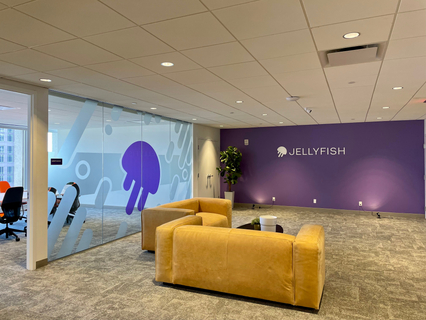
Open office floor plan to encourage communication and collaboration
Uses an OKR operational model to clearly define goals and priorities
Utilizes an open door policy that encourages accessibility
